Campaign Log: The Crimson Dawn
Entry 01: The Aurora Disaster
Location: Commercial Cruiser Aurora, Deep Space. Status: Structural Collapse / Emergency Evacuation.
The commercial cruiser Aurora, a modular passenger and cargo transport vessel, had just transitioned out of drive space. Without warning, the impact of what appeared to be a smart mine—an automated weapon remnant from the war—completely destroyed the bow section. The subsequent chain reaction caused the macrostructure to twist and fracture, leaving the cars exposed to the vacuum one by one.
Chronicle of the Escape
- The horror of the void: The compartment directly ahead of ours suffered a catastrophic rupture. Through the reinforced glass of the hatch, we witnessed a hellish scene: a segment of the adjacent fuselage detached completely, exposing the interior to space. We watched passengers perish victims of explosive decompression, ebullism, and fulminant hypoxia, as their bodily fluids suddenly vaporized from the drastic pressure drop. There was no sound at all, only the visual chaos of disintegration.
- Gravity failure: Artificial gravity failed intermittently in our car. The thunder of twisting metal was a constant reminder that our time was running out, while red emergency lights dyed the corridor.
- The bridge to the bulkhead: Since our section’s pods had been rendered useless, we headed toward the aft. The armored hatch was jammed due to hull torsion. The Mechalus medic, Tarek Ionis, performed an electronic bridge to the magnetic solenoids and managed to open a breach just seconds before the car was permanently sealed.
- Cargo section: Here, gravity was still functional thanks to the vessel’s modular design, similar to the cars of a train. Fortunately, the damage to the bow triggered safety systems, and the cargo section decoupled automatically, halting the structural collapse. Some of us proceeded to search for our gear containers in the logs, while others forced random crates to rescue any useful belongings.
- Engineering: Amidst the chaos, we intercepted the engineering team—Sam Logan, Clara Ananta, and a severely wounded Mathew Nadir. They were fleeing the reactors, which had suffered an overload and were out of control. The personnel managed to load additional equipment into our escape pod: a weight neutralizer cart full of supplies of an unknown nature.
- The extraction: We boarded the pod with utmost urgency. Seconds after ejection, the Aurora’s engineering section collapsed completely. With no atmosphere to allow for a visible explosion, we observed the ship fold in on itself until the reactor failure incinerated the interior in a flash of white plasma. All that remained was a frame of sheet metal and molten slag.
Entry 02: Adrift and Landing
Location: Salvage Pod Model 7-E / Unknown Planetary Surface. Duration: 121 hours adrift.
What should have been a miraculous escape transformed into a slow physical and moral degradation within a ten-square-meter habitacle.
Chronology of the Drift
- Day 1: Cold numbers. Mathew Nadir was bleeding out from explosion wounds. Tarek Ionis calculated that the expenditure of medical supplies was inefficient, given that the engineer lacked any real chance of survival. Therefore, he limited himself to minimal palliative care. Mathew passed away that same night, establishing a climate of deep distrust and horror within the pod.
- Day 2: The duffle bag. The stench of decomposition, added to the desperation, became intolerable. To fit Mathew’s body—already in rigor mortis—into a duffle bag, we had to dislocate his arms. We sealed the edges with industrial adhesive tape in a desperate attempt to contain the fluids and smell within the recycled air system.
- Day 3: Tony’s outburst. Post-traumatic stress and confinement broke Tony Skigrocu. His violent psychotic break put the entire group in grave danger, forcing us to physically restrain him. We had to sedate him with high doses of tranquilizers to keep him controlled, pushing him almost to the edge of unconsciousness.
- Day 4: Contrasts. Hunger and carbon dioxide-saturated air consumed us. Basilio Zuzunaga (“Zuzu”) remained in an absolute and frankly disturbing calm. In contrast, Ssi-T’krik couldn’t stop moving in the few available centimeters, while Makya clung to her bow, her nerves shattered.
- Day 5: Breaking point. Tony’s body built up resistance to the sedatives, and the crewmember regained his combative will in what could be considered a fit of Intermittent Explosive Disorder. During a fit of paranoid lucidity, he violently lashed out at the group. In reaction, Marcus, who was also at his limit, drew his weapon and pointed it at the people surrounding him, trying to keep them at bay. A massacre was imminent, but the planetary proximity alarm interrupted the tension: the pod was already descending toward the surface, following sensor readings of some sort of building. This event was the one that resolved the extreme tension between Tony, Marcus, and the rest of the passengers in the pod just before a tragedy occurred.
The Landing
Images captured by the pod’s guiding system during the descent:
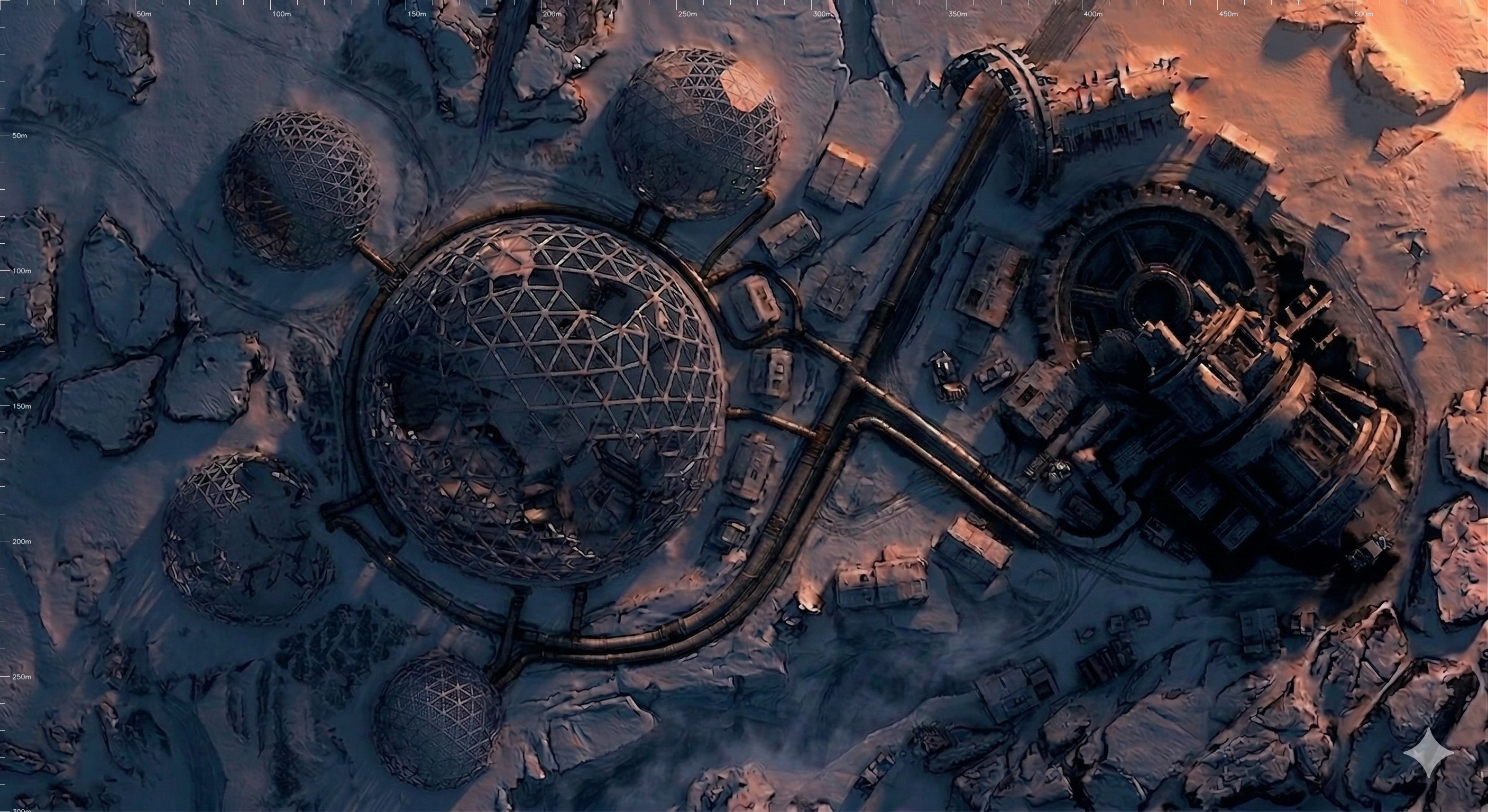
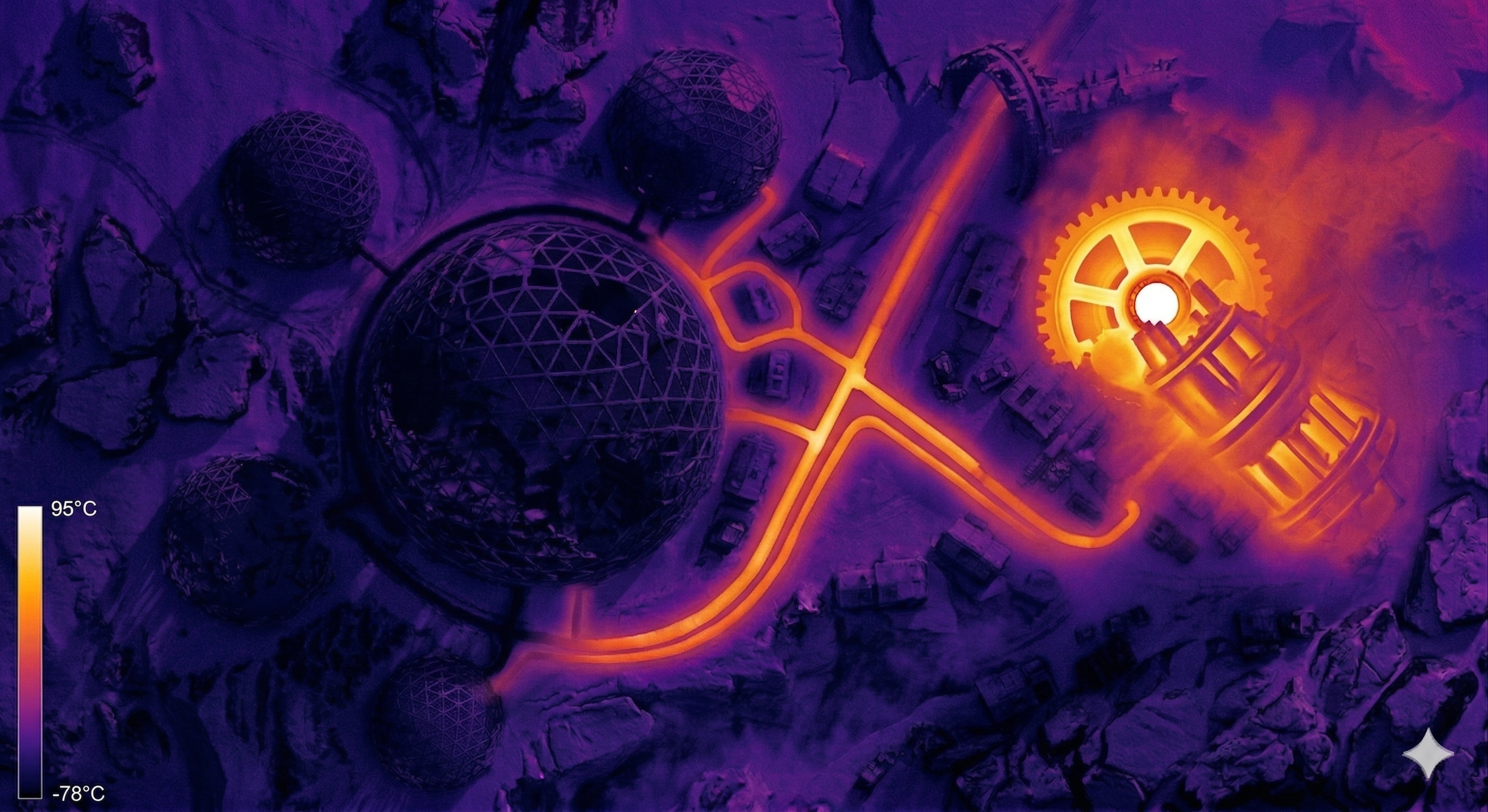
We made contact on a dry ice wasteland. As we landed on the planet, we could see frozen ruins through the pod windows. Sensors indicate we are on the dark side of a tidally locked planet (that is, the star permanently faces the same side toward its sun).
Ruins of an ancient colony rise 468 meters from the capsule. The computer systems failed in their attempt to identify the planet, leaving us with more questions than certainties. In the distance, over the horizon, a constant orange glow is silhouetted.
Status Report:
- Tony Skigrocu remains armed and extremely agitated.
- Mathew’s body remains sealed at the bottom of the pod.
- The external conditions are lethal: temperatures of -100°C and a crushing atmospheric pressure of 3.5 Earth atmospheres (which explains our gentle descent). At that pressure, walking feels like moving submerged in a liquid, and the winds are solid currents against which it is almost impossible to resist.
- Our location is uncertain. The emergency beacon constitutes our only cry for help in the void.
Survival Inventory
- Sustenance: Water and NutriMix (MeatLoaf/BBQ) for 12 people for 30 days.
- Personal Gear: 12 sleeping bags, 12 thermal units, 12 environmental suits (9 Soft class, 3 Hard class—one adapted for T’sa physiology).
- Medical Supplies: 6 Trauma Pack I, 1 Med Kit, Pharmaceuticals (worth 1,000 cr), 1 MedCare One.
- Heavy Logistics: 2 Gliese 300b Domes with coupling corridors, Cart with Weight Neutralizer (10,000 Kg/h capacity), heavy tools, and 1 Universal Charger.
Entry 03: Telemetric Analysis and Deployment
Location: Landing zone, thermal scan of the ruins. Status: Pod abandonment / Start of exploratory march.
After landing, we took a reasonable amount of time to analyze the telemetry the pod gathered about the ruins during our descent. Finding ourselves finally on solid ground, and despite the overwhelmingly inhospitable environment, the group has regained a slight but necessary measure of hope.
The site is a wasteland of ice and rock. Sensors ratify temperatures of -100ºC and an atmospheric pressure of 3.5 atmospheres (Earth standard). Under such pressure, any movement is exhausting; if not for the environmental suits, the mere density of the air would collapse our lungs instantly. The terrain, steep and filled with jagged rock formations, makes transit even more difficult. However, the high atmospheric pressure has a secondary effect: any fall is significantly slowed down, granting a sensation of movement similar to walking on the floor of a deep pool. Those with swimming experience shared precise instructions to conserve physical stamina in these types of dense fluids, while zero-g mobility guidelines also proved very useful for optimizing the group’s effort.
Thermal imagery yielded vital information about the ruined facilities. We have detected what appears to be heavy machinery emitting enormous volumes of heat, enough to raise the temperature of its immediate surroundings to about -60ºC. While it remains a lethal cold, this thermal difference drastically increases our survival chances. Readings also show a network of conduits explicitly designed to transfer that heat throughout the surrounding macrostructure.
After a brief deliberation, the course of action was set. We proceeded to suit up in the environmental suits, dismantled the pod’s mass reactor, and loaded all our equipment onto the weight-neutralizer traction cart. In a few moments, we will leave the impact zone behind to enter the ruins in search of that imperative heat source that could save our lives.
Entry 04: The Thermal Current and the Shelter
Location: Perimeter of the ruined complex. Status: Base camp established / Critical physiological exhaustion.
Upon forcing the hatch open, the reality of the exterior hit us with overwhelming force. The sudden increase in pressure made the suit seals creak, and those of us wearing Soft-class gear immediately received emergency system notifications: our suits wouldn’t withstand such compression for more than a couple of hours.
We began a tortuous advance toward the ruins, moving through air so dense it seemed to oppose physical resistance at every step. The expedition was about to claim its first victim when one of the crewmembers sank a foot into a pit disguised by frost. Freeing them required surgical precision; we had to fracture the ice trapping them, aware that the edges, sharp as obsidian shards, could tear the suit’s pressurization at the slightest slip.
With the incident resolved, we continued the march until crossing the facilities’ thermal threshold. The telemetry hadn’t been wrong: the heat emanated by the ruins generated a drop in atmospheric pressure, but the laws of thermodynamics demanded their tribute. The clash between the freezing mass and the warm sector engendered a powerful convective current. Literally, an invisible atmospheric river dragged us toward the complex. We were forewarned but lacked any agency over our bodies; we were sucked in and then violently expelled by an updraft. Projected by the dense air, we impacted the upper dome of the central hub only to end up descending, in an agonizing slow motion, toward the opposite sector. It was a brutal and disorienting maneuver, but the density of the air itself saved us from suffering multiple fractures.
Once stabilized, we found that moving alongside the thermal conduits was considerably easier. We recovered the supply cart and proceeded to establish a beachhead. We assembled our own habitats next to the surviving duct network, coupling them precariously but effectively. Finally, after six days of confinement and continuous terror, we managed to erect a decent shelter.
We dedicated our last energy reserves to performing a perimeter sweep. The architectural panorama proved as revealing as it was disconcerting. The settlement consists of a titanic central dome, about 140 meters in diameter, flanked by four smaller 60-meter domes. It is evident that the peripheral structures were abandoned long before the central complex; they exhibit asymmetric deterioration and, worse yet, lack the shielding or insulation necessary to tolerate this barometric hell. This disparity suggests a terrifying conclusion: this planet’s climate suffered a radical cataclysm since the first foundations were built.
The reconnaissance of the smaller facilities yielded mixed results: The first perimeter dome denoted a former agricultural use but was sterile; every last particle of soil had been removed decades ago. The second habitacle was a success. It seemed to have functioned as a workshop or vehicle hangar. We managed to outfit it, redirecting the thermal flow to integrate it into our shelter. The third dome, also agricultural, was in relatively good condition. There we obtained our most valuable find to date: an intact emergency seeding kit, which includes viable seeds and a terminal with cultivation protocols.
The fourth and last perimeter dome shared the same agricultural function, but its structure had collapsed almost irreversibly. Our approach to this sector nearly ended in tragedy: the perimeter was guarded by an automated defense turret, comparable in characteristics to an assault rifle. The mechanism, amazingly still operational, managed to lock onto us and fire a couple of shots. To our immense fortune, the crushing atmospheric density slowed the projectiles’ inertia within a few meters. Almost simultaneously, the extreme weather proved to be our greatest ally: cryogenic temperatures had made the weapon’s metal extremely brittle. The vibration and brutal pressure of the initial detonations themselves caused the turret barrel to fracture into pieces, leaving it inoperative after a few bullets. Having overcome this unexpected and lethal hurdle, and despite the obvious risk of collapse, we managed to scavenge its interior and extract plantable substrate along with a considerable stash of accelerant nutrient solutions.
The final incursion was reserved for the central macrostructure. Its dome exhibits a massive fracture, allowing dry ice to devour the interior. The chamber has the appearance of a gigantic data processing center or research laboratory; rows of computers and servers lie buried under the frost. In the heart of this vast chamber stands an imposing tower that, judging by its intricate network of hoses and biosensors, served as an industrial-scale hydroponic vertical farm.
Reviewing and purging that equipment in search of operational terminals will require a monumental effort, but we have nothing left to give. Having operated uninterruptedly for 26 hours in this freezing abyss, added to the brutal psychological wear of the drift, the group’s physiological collapse is absolute. Without electricity, but sheltered under tolerable pressure and heat, we have had no choice but to give in. We have retreated to our small domes with a single purpose in mind: to sleep.